Meaningful Communication That Motivates Teams

Motivating Teams Through Meaningful Communication
Motivation rises when people feel understood, informed, and valued. Meaningful communication is more than frequent updates—it’s clarity, context, listening, and follow-through. When managers communicate in a way that reduces ambiguity and respects people’s time and reality, teams spend less energy decoding “what leadership really means” and more energy doing great work.
Why communication is a motivation tool (not just a management task)
Communication shapes how employees interpret priorities, setbacks, and success. It also sets the emotional tone for whether people feel safe to take initiative or afraid to make a mistake.
- Connects effort to purpose: Employees stay engaged when they understand the “why” behind priorities and trade-offs.
- Reduces uncertainty: Clear expectations lower stress, second-guessing, and decision fatigue.
- Builds psychological safety: Respectful, consistent communication encourages questions, learning, and ownership.
- Signals fairness: Transparent decisions and consistent standards prevent rumors and quiet disengagement.
- Creates momentum: Timely recognition and feedback reinforce progress and persistence.
Gallup’s workplace research consistently links engagement to outcomes leaders care about—retention, productivity, and performance. See Gallup’s employee engagement insights for a useful overview of why engagement is a business issue, not a “soft” one.
What “meaningful” looks like in day-to-day leadership conversations
Meaningful communication can be repeated because it’s built on a few dependable ingredients—employees learn what to expect from you, which makes work feel steadier even when the environment is not.
- Clarity: Specific goals, owners, deadlines, and success criteria.
- Context: What changed, why it matters, and how to prioritize.
- Care: Acknowledgment of constraints, workload, and human realities.
- Consistency: Recurring rhythms (1:1s, team check-ins) that people can rely on.
- Two-way exchange: Questions, reflection, and documented next steps—not monologues.
Core communication practices that reliably boost motivation
Set expectations with precision
Motivation dips when employees can’t tell what “good” looks like. Define outcomes, boundaries, and decision rights: What must be true when the work is done? What constraints exist (time, budget, scope)? What can the employee decide without approvals?
Use “progress language”
Keep energy up by naming movement: what advanced since last time, what’s now unblocked, and what the next smallest step is. Progress language turns big goals into manageable motion.
Ask better questions
High-motivation teams aren’t free of problems—they surface them early. Questions that help include: “What’s the biggest blocker?” “What’s unclear?” “What would make this easier?” “What are we not talking about that could derail this?”
Close the loop
Trust grows when words turn into follow-through. Summarize decisions, confirm owners and deadlines, and revisit commitments. When something changes, say so explicitly and update the plan—silence is where frustration multiplies.
Make recognition concrete
Skip vague compliments and name behavior + impact + values: “You clarified the scope with the client, which prevented rework and protected the team’s time—that’s strong ownership.”
Choose the right channel for the message
Motivation can drop simply because the message traveled through the wrong medium. Sensitive topics need tone and nuance; complex changes need written reference; quick coordination needs structure.
| Situation | Best channel | Manager approach | What to document |
|---|---|---|---|
| Priority shift or new direction | Live meeting + written recap | Explain the why, trade-offs, and success metrics | New goals, owners, deadlines, decision log link |
| Performance coaching | 1:1 conversation | Use specific examples and invite employee perspective | Agreed next steps, support offered, follow-up date |
| Routine alignment | Weekly team check-in | Keep it short: wins, risks, next actions | Top priorities, blockers, dependencies |
| Recognition | Public channel (when appropriate) + 1:1 | Tie praise to impact and values | What was done, outcome, who benefited |
| Conflict or tension | Private conversation | Name the issue, listen, clarify expectations, agree on repair | Agreements and boundaries (brief, factual) |
As a practical guardrail: avoid delivering performance feedback via chat, and don’t bury critical context in a long thread. Create a simple team norm for where decisions live, how urgency is flagged, and expected response times.
Motivation-boosting 1:1s: a simple structure that works
Many 1:1s fail because they’re either status updates (which can be async) or therapy sessions without decisions. A simple structure keeps them human and useful.
Feedback that energizes instead of deflates
For a helpful perspective on why feedback should be treated as a conversation rather than a one-way “truth delivery,” see Harvard Business Review’s “The Feedback Fallacy”. For performance management fundamentals and manager guidance, SHRM’s performance resources are a solid reference.
Communication patterns that quietly drain motivation (and what to do instead)
A practical toolkit for leaders who want a repeatable approach
Digital guide for leaders and teams
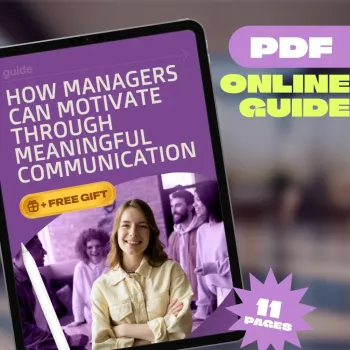
For managers who want a ready-to-use resource, Meaningful communication guide for motivating employees (digital download) provides practical structures, prompts, and examples to make everyday leadership conversations clearer and more consistent.
For leaders who do frequent walk-and-talk 1:1s, on-site check-ins, or travel between meetings, comfortable basics can help reduce friction in the day. Consider Calvin Klein Women’s White Leather Sneakers as a versatile option for a polished, all-day look.
FAQ
How can managers motivate employees through communication without sounding scripted?
Use a consistent structure—clarity, context, care, and next steps—while speaking in your natural voice. Refer to real work, real constraints, and specific impacts so the message feels grounded rather than rehearsed.
What’s the fastest communication habit that improves motivation?
Close the loop: summarize decisions, confirm owners and deadlines, and follow up when commitments are met or change. That one habit reduces confusion and signals reliability.
How often should managers give recognition to keep teams engaged?
Make recognition frequent and specific—small, timely notes tied to impact work better than occasional big praise. Align the style (public vs. private) to team norms and individual preferences.















Leave a comment