JetHexa Hexapod Robot Kit: ROS SLAM on Jetson Nano
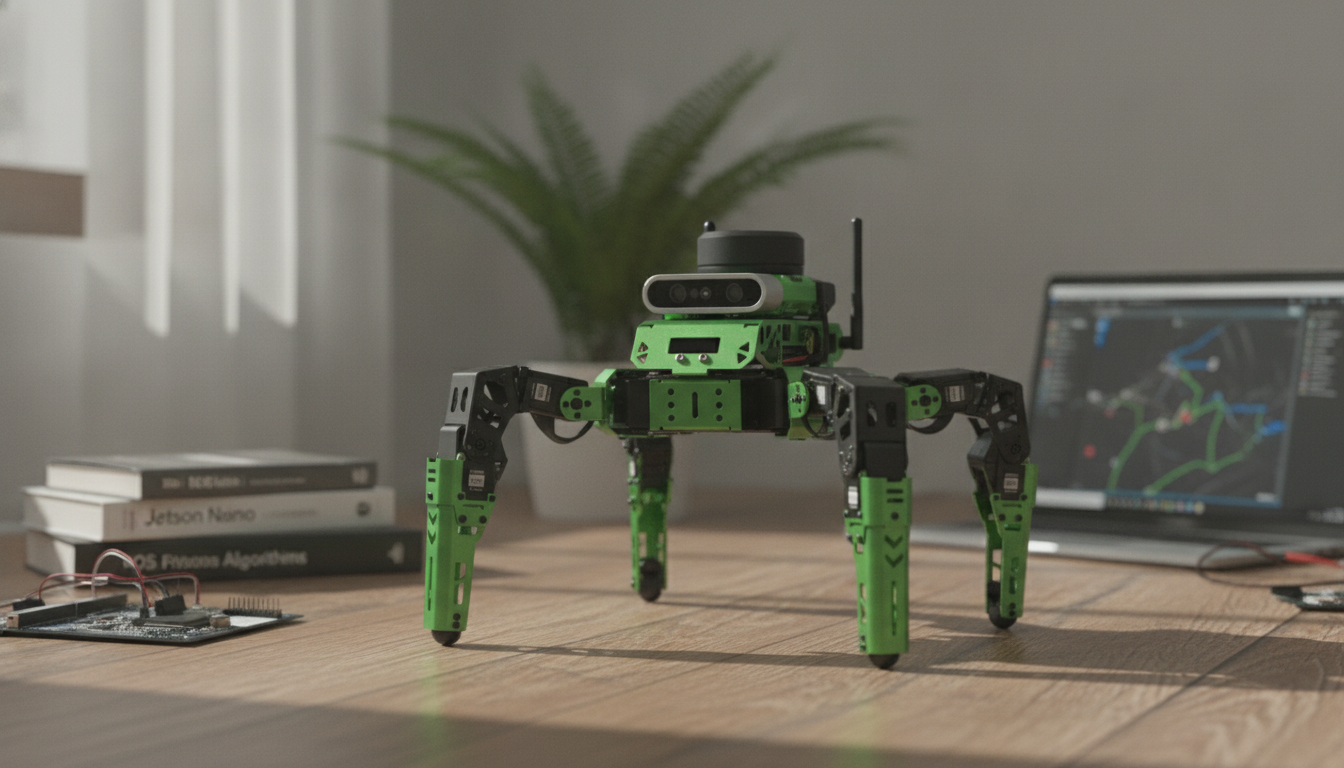
JetHexa ROS Hexapod Robot Kit with SLAM Mapping and Jetson Nano Power
JetHexa is a six-legged robotics kit built for hands-on work with ROS, onboard AI compute, and autonomous navigation workflows. With SLAM mapping and navigation capabilities on a Jetson Nano-based platform, it fits learning, lab prototyping, and research-style demos where stable walking and perception-driven motion matter.
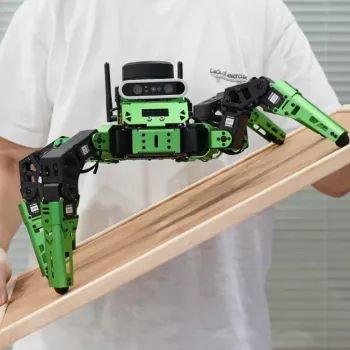
Compared with many entry-level wheeled robots, a hexapod’s gait can help it keep moving over thresholds, cables, and uneven indoor surfaces. At the same time, legged motion adds new tuning considerations for mapping and localization—making JetHexa a practical platform for understanding how real-world mechanics affect the robotics software stack.
What the kit is designed to do
- Provide a six-legged (hexapod) walking platform suited to uneven indoor surfaces where wheeled bases may struggle.
- Run a ROS-based software stack for modular development, testing, and integration with common robotics tools.
- Support SLAM mapping and navigation workflows to move from teleoperation to autonomous point-to-point behavior.
- Leverage Jetson Nano compute for running perception pipelines and robotics nodes on-device.
- Serve coursework, robotics clubs, capstone projects, and early-stage research prototypes.
For background reading on the underlying concepts and tooling, see the Robot Operating System (ROS) documentation and an overview of Simultaneous Localization and Mapping (SLAM).
Core capabilities to look for in SLAM and navigation builds
Successful autonomy demos usually come down to consistency: consistent sensor timing, consistent transforms, and consistent motion. When evaluating or configuring a SLAM-and-navigation setup, focus on the capabilities below.
- Mapping: building a 2D/3D representation while moving, with loop closure behavior depending on the chosen SLAM package.
- Localization: estimating the robot pose on an existing map for repeatable navigation.
- Path planning: global plan generation and local obstacle avoidance tuned for a legged platform’s motion characteristics.
- Sensor fusion: combining IMU/odometry and range/vision data to stabilize pose estimates.
- Recovery behaviors: handling temporary tracking loss, re-localization, and safe stop conditions.
SLAM-to-navigation workflow (typical ROS pipeline)
| Stage | Goal | What to verify during setup |
|---|---|---|
| Sensor bring-up | Publish reliable topics | Stable timestamps, correct frames (TF), consistent update rates |
| SLAM mapping | Build a map while exploring | Map quality, loop closure performance, drift behavior |
| Localization | Track pose on the saved map | Re-localization after occlusion, accuracy near corners |
| Planning + control | Move to goals safely | Footprint/costmap settings, conservative speeds, obstacle handling |
| Tuning | Improve stability and repeatability | Gait parameters, controller gains, costmap inflation |
Jetson Nano benefits for robotics workloads
On a robot intended to map, localize, and navigate, compute headroom matters. Jetson Nano provides enough on-device capability to run multiple ROS nodes while also supporting accelerated AI inference workflows that can complement SLAM—such as object detection, semantic cues, or depth-related perception when applicable.
- Less tethering: on-device compute reduces dependence on a workstation for demos and experiments.
- More concurrency: better suited than microcontroller-only platforms for running perception plus navigation nodes at the same time.
- Practical deployment lessons: thermals and power budgeting matter; sustained loads benefit from sensible heatsink/fan setup and conservative performance modes.
For platform details and best practices, reference NVIDIA Jetson Nano resources.
Legged navigation: what’s different compared with wheeled robots
Navigation stacks and SLAM packages often assume relatively smooth, continuous base motion. A hexapod changes that assumption: motion can be stable, but it’s inherently periodic, and that affects sensing and control.
- Gait stability affects sensor quality: excessive body oscillation can degrade SLAM performance and localization consistency, especially for vision-based pipelines.
- Foot placement and step timing matter: these influence how smoothly the robot threads narrow indoor spaces and how predictable turns feel in local planning.
- Speed expectations are different: safer indoor autonomy typically prioritizes stability and repeatability over top speed.
- Planning must match the real footprint: costmaps, inflation radius, and turning behavior should reflect the actual geometry and how the legs sweep during gait cycles.
Setup checklist before the first autonomous run
Before commanding a full autonomous goal, validate the foundations. A short, disciplined bring-up sequence saves hours of chasing “mystery drift” later.
Who this kit fits best
Product details and purchase link
Product name: JetHexa ROS Hexapod Robot Kit SLAM Mapping and Navigation Enabled, Jetson Nano Powered
At-a-glance
| Item | Value |
|---|---|
| Price | 1456.49 USD |
| Stock status | In stock |
| Platform type | Hexapod (six-legged) |
| Compute | Jetson Nano powered |
| Autonomy focus | SLAM mapping and navigation enabled |
Other in-stock picks
- Spacious 6-8 Person Waterproof Camping Tent with Three Rooms
- Elegant Women’s Genuine Leather Sandals
- Furla Women’s Green Leather Pumps
FAQ
What is SLAM and why is it useful on a hexapod robot?
SLAM stands for simultaneous localization and mapping: the robot builds a map of an area while also estimating its position within that map. On a hexapod, SLAM is especially useful because it enables autonomy in spaces where legged mobility helps, while stable pose estimation remains critical for reliable navigation.
Does a Jetson Nano help with ROS navigation, or is it mainly for AI?
Jetson Nano can help with both: it can run ROS navigation nodes and supporting perception on-device, which reduces dependence on an external computer. It also benefits real-time vision workloads, but good results still depend on careful tuning plus sensible power and thermal setup.
What should be tested first after assembly before enabling autonomous navigation?
Start by verifying the TF tree, confirming sensor topics and timestamps are stable, and checking basic teleoperation control. Next, do a teleop mapping pass and save the map, then test localization on that map before enabling full planning and autonomous goal execution.













Leave a comment