Quiet Your Inner Critic: 3-Step Reset for Self-Talk

A Friendly Guide to Dismantling Your Inner Critic: Practical Steps to Transform Negative Self-Talk
An inner critic can sound like “not good enough,” “you always mess up,” or “why even try?”—and it often shows up most when growth matters. The goal isn’t to erase every negative thought; it’s to change the relationship with that voice so it stops running the day. Below is a clear, supportive path for noticing the pattern, reducing its intensity, and replacing it with steadier, more accurate self-talk.
What the inner critic is (and why it feels so convincing)
The inner critic is a learned mental pattern that uses harsh evaluation to prevent mistakes, rejection, or discomfort—often shaped by past experiences, pressure, and reinforcement. In a strange way, it’s trying to keep you safe.
It feels “true” because it arrives fast, speaks in absolutes (always/never), and targets identity (“you are…”) instead of behavior (“that choice didn’t work”). When criticism masquerades as motivation, it can seem productive—yet chronic self-attack usually raises stress and increases avoidance rather than creating steady change. Prolonged stress also affects the body’s systems in measurable ways, which can make it even harder to think clearly and respond calmly (see the American Psychological Association’s overview of stress effects on the body).
Common triggers include uncertainty, comparison, high stakes moments, fatigue, and situations that resemble earlier shame or intense expectations. Knowing the triggers isn’t about blame; it’s about recognizing patterns so you can interrupt them.
Spot the critic’s scripts: patterns, distortions, and trigger loops
Start by listening for repeated phrases and themes—perfectionism, people-pleasing, fear of failure, or fear of being “too much.” Many inner-critic messages follow predictable thought distortions. Instead of debating the thought, name the distortion and move on: catastrophizing, mind-reading, all-or-nothing thinking, discounting positives, and overgeneralizing.
Next, track the loop: trigger → critic message → emotion (shame/anxiety) → coping (procrastination, overworking, withdrawal) → short-term relief → stronger critic later. That “relief” teaches the brain to keep using the same loop, even if it makes life smaller over time.
A quick self-check can help: “Is this feedback specific and actionable, or global and punishing?” Specific feedback can be useful; global punishment rarely is.
Common inner-critic messages and kinder replacements
| Critic message | What it’s trying to protect | Supportive reframe | Small next step |
|---|---|---|---|
| “You’re going to fail.” | Avoiding disappointment and judgment | “Uncertainty is uncomfortable, not unsafe. Preparation helps.” | Do a 10-minute starter task |
| “You’re not good enough.” | Preventing rejection | “Worth isn’t earned by perfection. Skills grow with practice.” | List 2 skills improving this month |
| “If it’s not perfect, don’t do it.” | Reducing risk | “Done and revisable beats frozen and unfinished.” | Create a rough draft version |
| “Everyone is ahead of you.” | Seeking belonging | “Comparison hides context. Progress is personal and non-linear.” | Measure progress vs. last week |
| “You always mess things up.” | Preventing repeat pain | “One mistake is data, not identity.” | Write one lesson learned |
How to respond in the moment: a 3-step reset
Step 1 — Notice and label: “That’s the inner critic.” Labeling creates distance. You’re no longer inside the thought; you’re observing it.
Step 2 — Regulate the body: Try a slow exhale (longer out-breath than in-breath), unclench your jaw and shoulders, and feel your feet on the floor. A calmer nervous system makes balanced thinking more available. If you want a broader set of basics for mental well-being, the National Institute of Mental Health guide to caring for your mental health is a solid starting point.
Step 3 — Choose a compassionate script: Talk to yourself like a steady mentor would—clear, honest, and non-shaming. Helpful phrasing: “This is hard and I can take one step.” / “I can be a work in progress and still show up.”
Replace self-attack with self-coaching (without sugarcoating)
Self-coaching doesn’t mean pretending everything is fine. It means switching from identity-based attack to behavior-based adjustment. Replace “I’m terrible” with “That approach didn’t work; here’s what to adjust.”
Aim for accuracy over positivity. The most effective counter-voice is believable, not overly upbeat. You can also use “compassionate accountability”: validate the feeling, then choose the next doable action. This is closely aligned with how cognitive behavioral therapy approaches thoughts and behavior patterns (see the NHS overview of CBT).
Build a long-term practice: routines that weaken the critic over time
Guided support: a structured path for emotional growth
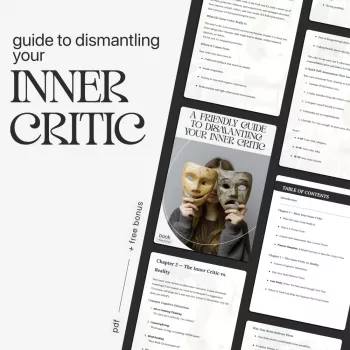
If you want a supportive, structured approach, explore A Friendly Guide to Dismantling Your Inner Critic (digital eBook) for practical exercises that turn negative self-talk into steady self-coaching.
And because an inner critic often spikes around money pressure and “I should have it together” thoughts, Master Your Paycheck: The Smart, Calm, and Confident Way to Save Your Salary can be a helpful companion for building calmer routines and reducing one common source of self-judgment.
FAQ
Is an inner critic always a bad thing?
No. Self-evaluation can be useful when it’s specific and actionable; the issue is chronic, identity-based shaming that increases anxiety, stress, and avoidance rather than helping you improve.
How long does it take to quiet negative self-talk?
You can feel a shift quickly with labeling and a simple reframe, but lasting change usually comes from repetition over weeks or months. Progress is often non-linear, especially during high-stress seasons.
What if the inner critic gets louder when trying to change it?
That pushback is common when a long-standing habit is disrupted. Return to body regulation, use more neutral language if compassion feels “too far,” and take small steps; if distress feels intense or unmanageable, professional support can help.














Leave a comment