Overcome Fear of Failure: 7-Day Confidence Reset

Fear of failure often looks like procrastination, overthinking, or quietly avoiding opportunities that matter. The good news: it isn’t a personality flaw—it’s a protective pattern the brain uses when something feels risky, uncertain, or socially exposed. With a few practical mindset tools and a simple practice plan, it becomes possible to take smarter risks, learn faster, and build steady confidence without needing perfection.
What fear of failure really is (and how it shows up day to day)
Fear of failure is less about the event of failing and more about what failing might mean: judgment, regret, disappointment, or “proof” that you’re not good enough. That meaning creates avoidance.
- Common signs: delaying decisions, quitting early, perfectionism, people-pleasing, excessive research, or “staying busy” instead of starting.
- The hidden cost: missed opportunities, lower self-trust, and a shrinking comfort zone.
- Why it persists: the brain treats uncertainty and social judgment as threats, so avoidance becomes a short-term relief habit.
- Reframe: failure is feedback about strategy and skill—not a verdict on personal worth.
Where the fear comes from: perfection, identity, and uncertainty
Most fear of failure runs on a few common mental loops. Once you can name the loop, you can interrupt it.
- Perfectionism loop: “If it can’t be guaranteed, it’s unsafe to try.”
- Identity fusion: linking outcomes to self-worth (“If I fail, I am a failure”).
- All-or-nothing thinking: seeing attempts as pass/fail instead of progress.
- Past experiences: harsh criticism, comparison, or high-stakes environments can train avoidance.
- Uncertainty intolerance: discomfort with not knowing becomes a reason to stall.
One of the most effective antidotes is a growth mindset: treating ability as something that can improve through effort, feedback, and iteration. Stanford’s overview of growth mindset offers a helpful foundation for this shift: https://mindsets.stanford.edu/.
A simple shift: from outcome goals to process commitments
Outcome goals (promotion, launch, grades) can be inspiring, but they’re not fully controllable day to day. Process commitments put the focus on what you can do this week—so you build agency, consistency, and momentum.
- Outcome goals are motivating but uncontrollable in the short term.
- Process commitments (reps, outreach, drafts, practice sessions) rebuild follow-through.
- Minimum viable effort on hard days keeps your identity intact: “I’m someone who follows through.”
- Track inputs, not just results: reps completed, feedback gathered, lessons logged.
Outcome vs process examples
| Area | Outcome goal | Process commitment (weekly) |
|---|---|---|
| Career | Get a new role | Apply to 5 roles, do 2 informational chats, refine 1 story for interviews |
| Business | Launch a product | Draft 3 pages, test 1 offer, message 10 potential customers |
| Creative work | Publish consistently | Create 2 rough drafts, edit 1 piece, share 1 work-in-progress |
| Fitness | Lose a set amount | Complete 3 workouts, prep 2 meals, walk 20 minutes on 4 days |
Tools that reduce fear in the moment (so action becomes easier)
When fear spikes, the goal isn’t to “win” an internal debate—it’s to reduce uncertainty enough to take one concrete step.
- Name the fear precisely: “I’m afraid I’ll be judged,” “I’m afraid I’ll waste time,” “I’m afraid I’ll disappoint someone.”
- Scale it: rate the risk (1–10) and list realistic consequences versus imagined ones.
- Use a two-path plan: Plan A (best-case action) and Plan B (recovery step if it goes wrong).
- Time-box rumination: give yourself 10–15 minutes to think, then move to a single next step.
- Exposure by design: take small, repeatable risks (ask, pitch, share, submit) until discomfort drops.
If fear starts to feel persistent or overwhelming, it can overlap with anxiety patterns. The National Institute of Mental Health provides a clear overview of anxiety disorders and support options: https://www.nimh.nih.gov/health/topics/anxiety-disorders.
Building confidence the reliable way: evidence, not hype
- Collect proof: finished sessions, sent messages, submitted drafts, practiced skills—even if results are mixed.
- Create a wins log: small actions count (sent the email, practiced 10 minutes, asked for feedback).
- Practice self-compassion: it reduces shutdown after setbacks and supports persistence and learning. The American Psychological Association summarizes the benefits here: https://www.apa.org/topics/self-care/self-compassion.
- Adopt a learning identity: “I’m the kind of person who improves through attempts.”
A 7-day reset plan to start taking action this week
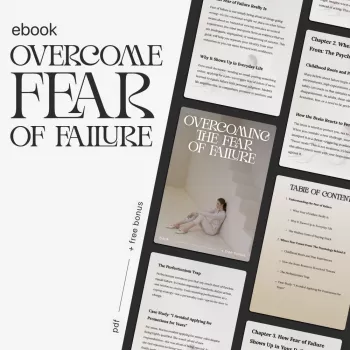
A guided way to go deeper: Overcoming the Fear of Failure (Digital eBook)
For a structured approach, Overcoming the Fear of Failure (Digital eBook) is built around practical exercises that turn insight into daily behavior change. It helps separate self-worth from outcomes and replace avoidance with repeatable action steps—useful for work goals, creative projects, studying, and entrepreneurship.
Quick product snapshot
| Format | Price | Best for | Link |
|---|---|---|---|
| Digital eBook | 13.99 USD | Mindset growth, confidence building, overcoming avoidance | View product |
Helpful companion habit: staying calm and consistent with money goals
If a steady paycheck plan would reduce stress and decision fatigue, Master Your Paycheck: The Smart, Calm, and Confident Way to Save Your Salary (Digital Guide) is a clear, calm system you can revisit whenever money feels overwhelming.
FAQ
How do you overcome fear of failure when starting something new?
Start with a small, time-boxed first step (5–15 minutes), switch to process commitments (reps per week), and create a recovery plan so your brain can see a safe path even if things don’t go perfectly.
Is fear of failure the same as procrastination?
They’re often connected. Procrastination can be an avoidance strategy that reduces anxiety in the short term, even when it increases stress and self-doubt later.
How long does it take to build confidence after repeated setbacks?
Confidence rebuilds through evidence: consistent reps, tracking small wins, and practicing self-compassion after mistakes. The timeline varies, but momentum usually appears once actions become routine and you’re collecting proof each week.














Leave a comment