Help Someone Rebuild Motivation: Tiny Steps That Work

From Lazy to Inspired: Practical Ways to Help Someone Get Moving Again
When someone looks “lazy,” the real issue is often hidden—overwhelm, anxiety, low mood, unclear goals, poor sleep, or a habit loop that makes starting feel harder than it should. The most effective support combines empathy, clear structure, tiny starting steps, and accountability that doesn’t shame. Below are simple, repeatable methods to help someone rebuild momentum—without power struggles.
Start by ruling out what looks like “laziness”
Before pushing motivation tactics, check whether something else is quietly blocking action. Many people want to move forward but feel stuck by factors that aren’t visible from the outside.
- Look for common blockers: chronic stress, burnout, depression, ADHD-related executive dysfunction, sleep deprivation, pain, medication side effects, or unresolved conflict.
- Notice patterns: does motivation drop for specific tasks (paperwork, cleaning, studying) but not others (gaming, chatting, hobbies)? That often signals avoidance, not lack of character.
- Use neutral language: describe observable behavior (“getting started has been tough lately”) instead of labels (“you’re lazy”).
- If there are signs of depression, self-harm, substance misuse, or inability to function day-to-day, encourage professional help and offer to assist with scheduling or logistics. Helpful overviews include the National Institute of Mental Health (NIMH) guidance on depression and the Mayo Clinic overview of depression symptoms.
Common reasons someone can’t get moving and what helps first
| What you see | Possible cause | Best first step |
|---|---|---|
| Procrastinates only on one category of tasks | Avoidance, fear of failure, unclear expectations | Clarify the next micro-step and reduce stakes |
| Can’t start anything even when it matters | Burnout, depression, sleep debt | Restore basics: sleep, light, movement; seek clinical screening if persistent |
| Starts then quits quickly | Overambitious plans, low reward, low energy | Shrink the goal; add immediate reward and tracking |
| Argues or shuts down when reminded | Shame, control struggles, feeling criticized | Switch to collaborative planning and choice-based prompts |
| Works well with deadlines only | Needs external structure | Use timed sessions, visible schedule, and accountability check-ins |
Talk in a way that reduces resistance
Motivation usually collapses under criticism—even “well-meaning” pressure. A calmer, permission-based approach lowers defensiveness and increases follow-through.
- Ask permission before advising: “Do you want ideas, or do you just want me to listen?”
- Reflect and validate first: “That sounds heavy. No wonder starting feels hard.” Validation lowers defensiveness and opens problem-solving.
- Use curiosity questions: “What part feels hardest—the start, the middle, or finishing?” and “What would make this 10% easier?”
- Avoid moralizing or comparisons (“others do it”); they usually increase shame and reduce action.
Make starting so small it feels almost silly
If someone is stuck, “try harder” is rarely the missing ingredient. The missing ingredient is a start that’s small enough to bypass dread.
- Use the 2-minute entry point: commit only to two minutes of the task (open the document, put one item away, put on workout clothes).
- Create a “start line” ritual: same time, same place, same cue (tea + timer; music + desk; shoes by the door).
- Define success as showing up, not finishing. Finishing can come later; consistency builds identity and momentum.
- If overwhelm is high, use “one square foot” cleaning or “one paragraph” studying to restore a sense of control.
If movement is part of the plan, make “getting ready” the win for week one. Something as simple as slipping into comfortable shoes can be the bridge between intention and action. A practical option is a dedicated walking pair like Calvin Klein Women’s White Leather Sneakers or Calvin Klein Jeans Women’s Beige Sneakers.
Design the environment so the default is action
Willpower is unreliable; environments are consistent. When the “right thing” is easy to start, it happens more often.
- Remove friction from good habits: lay out materials, pre-pack a bag, keep a simplified checklist in plain sight.
- Add friction to avoidance: log out of distracting apps, charge phone outside the bedroom, keep snacks and distractions away from the workspace.
- Use visual prompts: a sticky note with the single next action; a whiteboard with three priority items; a progress tracker.
- Bundle tasks with an immediate reward: favorite playlist only while cleaning; coffee only after the first study block.
Build accountability that feels supportive (not controlling)
Accountability works best when it protects dignity. The goal is shared structure, not surveillance.
Reset motivation with energy basics
For younger kids (or anyone who resists bedtime), consistent sleep cues can make mornings less miserable and starting less painful. A cozy, predictable night routine can start with comfortable sleepwear like the Cozy Velvet Winter Pajama Set for Boys.
A simple 7-day momentum plan
A guide for staying consistent when motivation is low
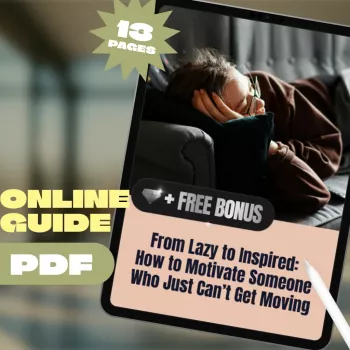
For a ready-to-use framework, consider From Lazy to Inspired: How to Motivate Someone Who Just Can’t Get Moving (Digital Guide).
FAQ
How do you motivate someone who is lazy without nagging?
Start with empathy and ask permission to share ideas. Agree on a tiny “start step” (like two minutes) plus a supportive check-in that tracks starting, not finishing, and avoid shame-based labels.
What if they say they want to change but never follow through?
Assume the plan is too big or too vague, not that they don’t care. Shrink it to a 2-minute entry point, add an environmental cue (timer, laid-out materials), and measure consistency instead of outcomes.
When is “laziness” actually a mental health concern?
If low motivation lasts for weeks and comes with persistent sadness, sleep or appetite changes, hopelessness, or difficulty managing daily life, it’s time to encourage a professional evaluation. Offering practical help with next steps (finding providers, setting appointments, transportation) can reduce the barrier to getting support.














Leave a comment