7-Minute AI Reframing Routine for Stressful Thoughts

Using AI to Transform Unhelpful Thoughts: A Practical Reframing Routine for Everyday Stress
Unhelpful thoughts can feel convincing, urgent, and personal—especially when stress is high. A simple AI-supported process can help slow the spiral, name the thinking pattern, and rewrite the thought into something more accurate, compassionate, and workable. This guide lays out a structured way to reframe in minutes while staying grounded in evidence-based principles like cognitive restructuring and cognitive reappraisal.
What “unhelpful thoughts” look like in daily life
Unhelpful thoughts often show up as mental shortcuts that sound certain but aren’t actually verified. Common signals include looping worries, harsh self-talk, catastrophic predictions (“this will ruin everything”), mind-reading (“they must be mad at me”), and all-or-nothing conclusions (“if I can’t do it perfectly, it’s a failure”).
Thoughts influence feelings and actions more than most people notice in the moment. A single interpretation—like “I’m in trouble”—can shift mood, motivation, and behavior within seconds, even if the situation is ambiguous.
A thought tends to be “unhelpful” when it’s rigid, extreme, vague, or treats feelings as facts. “I feel anxious, so something bad will happen” is a classic example: the emotion is real, but the conclusion may not be.
The goal of reframing isn’t forced positivity. It’s accuracy, choice, and calm—so the next step becomes clearer and more doable.
Why AI can help with reframing (and where it can’t)
AI can create psychological distance by turning an inner monologue into editable text. Once the thought is written out, it becomes easier to evaluate like a draft rather than a verdict.
AI is especially strong at generating alternative interpretations, neutral language, and simple next-step plans. It can also help label common thinking traps such as catastrophizing, overgeneralizing, and discounting positives—helpful categories used in cognitive restructuring (see the APA’s definition of cognitive restructuring).
Limits matter. AI is not therapy, cannot diagnose, and isn’t appropriate for crisis situations. If you’re experiencing severe or persistent anxiety symptoms, reviewing credible guidance like the National Institute of Mental Health overview on anxiety disorders can be a practical starting point for understanding options and seeking care.
Used well, AI functions like a journaling and coaching aid: a way to practice reframing consistently, while leaning on trusted mental health resources when needed.
A 7-minute AI reframing routine (repeatable and low-pressure)
Minute 1: Write the raw thought exactly as it appears
Type it word-for-word—no cleanup. If it’s harsh, let it be harsh. The point is accuracy, not politeness.
Minute 2: Add context and name the strongest emotion
Briefly describe what happened, what feels at stake, and which emotion is loudest (anxious, embarrassed, angry, guilty, sad). This reduces vagueness and makes the thought easier to test.
Minute 3: Ask for a thinking-trap scan and a “most likely” interpretation
Request a quick label (“mind-reading,” “catastrophizing,” etc.) and a grounded “most likely” interpretation to counter the brain’s tendency to leap to extremes.
Minutes 4–5: Generate three alternative rewrites
Ask for (1) a neutral rewrite, (2) a compassionate rewrite, and (3) an action-focused rewrite. Different tones work for different situations; having options helps you choose what fits.
Minute 6: Choose a rewrite that feels 70–90% believable
If it feels fake, it won’t stick. Aim for “plausible and steadier,” not “perfectly confident.”
Minute 7: Pick one tiny action aligned with the new thought
Choose an action that takes five minutes or less—send one message, set a timer, write one sentence, or take one step. Action is what teaches the nervous system that the new frame is safe enough to follow.
Prompt patterns that produce better rewrites
| Situation | Unhelpful thought | Thinking trap | More helpful rewrite | Small next step |
|---|---|---|---|---|
| Late reply to a message | They’re ignoring me because I said something wrong. | Mind-reading | They may be busy; I can follow up once and give it time. | Send a brief check-in and pause notifications for 30 minutes. |
| Mistake at work | I always mess things up. I’m not cut out for this. | Overgeneralizing | I made a mistake; I can correct it and learn the pattern to prevent it. | List the fix, then one prevention step for next time. |
| Upcoming event | This is going to be a disaster. | Catastrophizing | I feel anxious; the most likely outcome is manageable, even if imperfect. | Write a 3-point plan: prepare, arrive, exit strategy. |
Keeping it safe, private, and emotionally supportive
Turning reframing into a habit without overthinking it
Digital guide for step-by-step practice
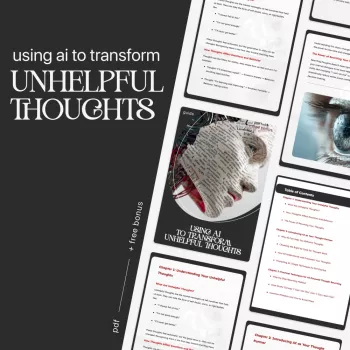
For a more structured approach, Using AI to Transform Unhelpful Thoughts (digital guide) offers a repeatable method for rewriting unhelpful thoughts with AI support, including quick-session templates and examples.
If money stress is a frequent trigger for spirals, Master Your Paycheck (digital guide) can help reduce day-to-day pressure with a calmer, clearer salary-management system—making it easier to reframe with real-world stability underneath.
FAQ
Is reframing the same as forcing positive thinking?
No. Reframing aims for accuracy and flexibility—often with a neutral, realistic rewrite like “There are a few possibilities here, and I can take one small step” rather than an overly upbeat statement.
Can AI replace therapy for negative thought patterns?
AI can support reflection and practice, but it can’t diagnose, treat, or provide crisis care. If distress is persistent or escalating, professional support is the safest and most effective next step.
What if the rewritten thought doesn’t feel believable?
Aim for a rewrite that feels about 70–90% believable, not perfect. Make it smaller, add concrete evidence, and use action-focused language that you can test in a five-minute step.














Leave a comment